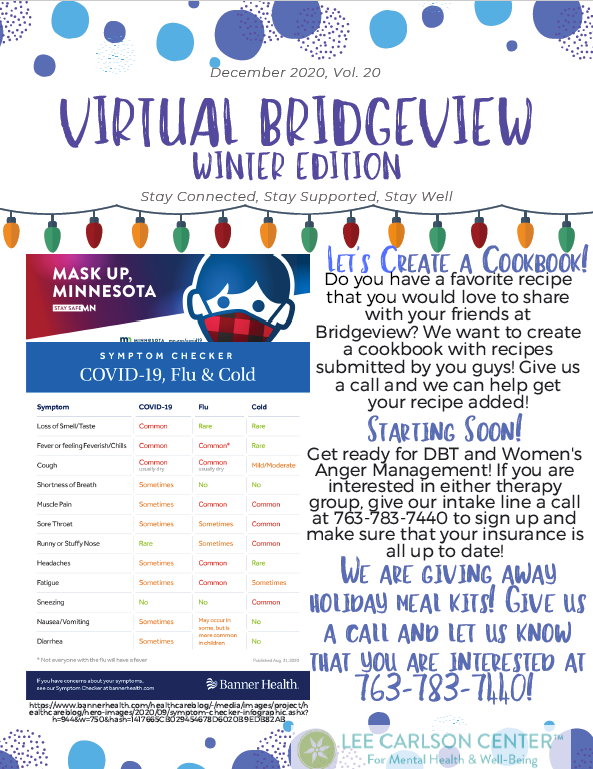

Its finally winter and Bridgeview will be active all season with virtual activities –
CHECK OUT OUR LATEST NEWSLETTER Dec 2020 Vol. 20

Its finally winter and Bridgeview will be active all season with virtual activities –
CHECK OUT OUR LATEST NEWSLETTER Dec 2020 Vol. 20
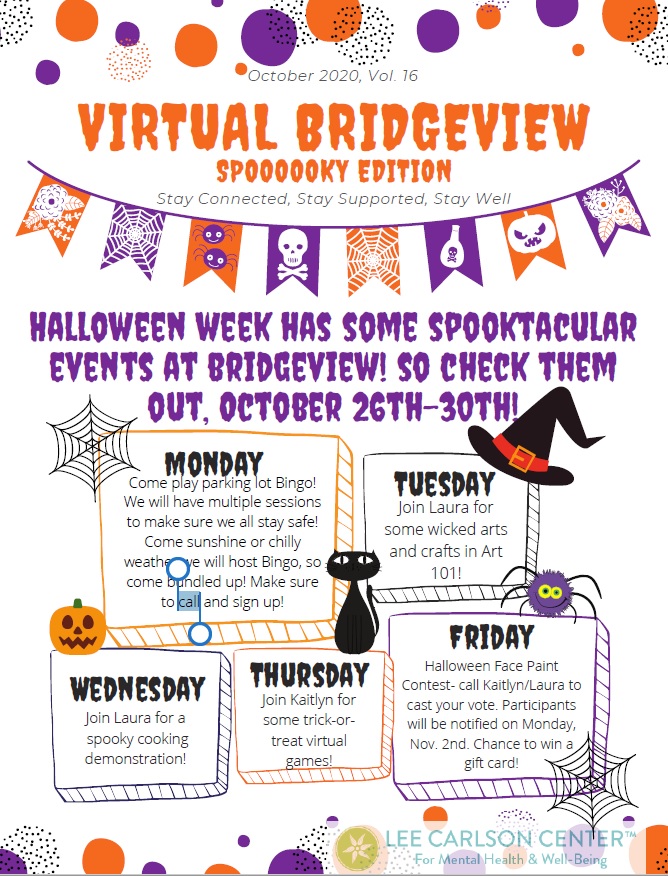
We hope you will enjoy our October Bridgeview Virtual Drop-in Center Newsletter hot off the press
Bridgeview Virtual Drop-in Announces Halloween Week Spooktacular Events at Bridgeview! October 26th-30th
Download our most recent newsletter and take a look https://leecarlsoncenter.org/wp-content/uploads/2020/10/Oct-2020-Vol.-16-3.pdf
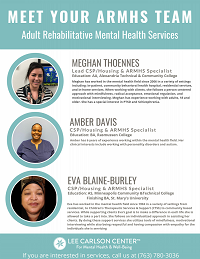
Virtual Support Groups, Recipes, Spotlight on our ARMHS Team, Virtual trip to the Zoo!
ITS ALL IN OUR WEEKLY VIRTUAL BRIDGEVIEW NEWSLETTER. See it here!
https://leecarlsoncenter.org/…/2…/04/April-2020-Vol.-4-5.pdf
40 years ago a group of parents, professionals and leaders in our community developed an idea for a community-based agency that could support children, families and adults in our community with a variety of needs that schools, county services, the hospital and medical community were not set up to support.
From that grass roots origin and through the synthesis of community energy, built on a strong foundation of partnership came Central Center for Family Resources a new non for profit organization in Anoka County and the north metro with a goal to address community needs in unique and customized ways that met each individual where they were at with the right intervention at the right time.
Over the years Central Center, now Lee Carlson Center for Mental Health and Well-being introduced peer support groups for school aged children then a drop-in center for adults seeking mental wellness. Later came Child Psychiatry and then a Domestic Abuse Program treating both aggressors and survivors.
By 2009, The agency already had strong roots in service to schools and school aged children and partnerships with multiple school districts when Central Center was renamed Lee Carlson Center as a tribute to a founding member and the agency’s first director, Lee Carlson.
Later the agency would become a full-scale licensed clinic and a resource to parents providing Restorative Parenting and helping re-establish strong bonds between parent and child after traumatic experiences. For the first time in 2014 Minnesota certified Lee Carlson Center as an Essential Community Provider because over half of the clients the agency served were living at or below poverty.
In more recent years and in keeping with tradition Lee Carlson Center has continued to respond to community needs. The needs have been growing intensely and the agency has met those needs in stride with the support of funders, numerous partnerships, a great team of front-line staff and staff leadership and a mission-driven board of directors. Together we have addressed the challenge of wait lists and added capacity in an effort to eliminate wait lists across many of our programs because “there can be nothing more difficult then waiting for a mental health service you need to today.”
Lee Carlson Center started an in-home mental health services program for children, families and adults and an intensive program for children living in foster care because our community needed greater access to these specialized services.
We expanded services to a record 65+ schools across 8 school districts over the past two years because the fact is, children and families need easy access to early interventions. Last year we served a Pre-K aged child and by the middle of Kindergarten that child was discharged from our program ready to meet the world of a school age child undeterred by the effects of debilitating mental illness.
Being located inside a school makes mental heath support accessible to many kids and families who would otherwise miss out on the right care at the right times having to get those services in the evenings or on weekends. Being linked with children in their school setting gives us a unique opportunity to impact academic trajectory in a positive way removing the barrier to educational progress that mental health conditions can create.
Lee Carlson Center now has 4 clinic sites ranging from central Anoka County to Northern Hennepin County and we have a laser focused vision to meet more needs in each community we serve building out all our service offerings in each of our locations. Today, most schools we serve are less than 10 minutes from a clinic site where we have the capacity to serve the entire family. Last year in fact we served a family of 8 across 5 of our programs creating needed Hope, Healing and Health for a family in need.
Our Bridgeview drop-in center has added new dimensions of care from employment support to housing support services and groups ranging from mental health support groups to Dialectical Behavioral Supports, innovative garden therapy and art therapy services, yoga, dance, social interaction opportunities, community activities and a healthy meal for members every day of the week. In fact, Bridgeview is such a healthy place that one member started visiting Bridgeview for mental health supports and was soon able to safely eliminate the need for high blood pressure medication.
This week was Gratitude Week at Lee Carlson Center. We spent time thanking all the staff who work tirelessly on our client’s behalf. These team members are an asset. All who support our mission play an important role. Each inspires us with their ability to “Keep Talking About Mental Health” Many friends of the agency send family and friends to us for support, we are humbled. Others contribute time, talent and financial resources to make this mission work. Our Mission to provide exceptional and affordable mental health services for families, children, youth, and adults in our community would not be possible without your support and generosity so thank you and thank you for celebrating 40 years of Lee Carlson Center for Mental Health and Well-being.
Rob Edwards
Chief Executive Officer
For More About Our History READ Lee Carlson Center Through The Years 1979-2019
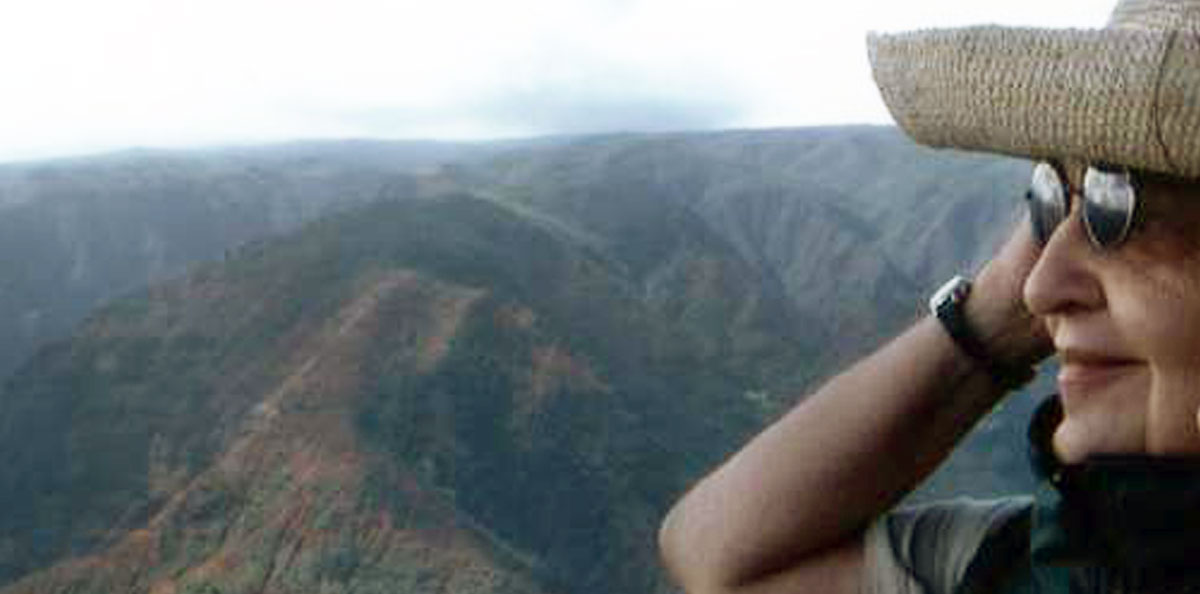
photo: Lee Carlson
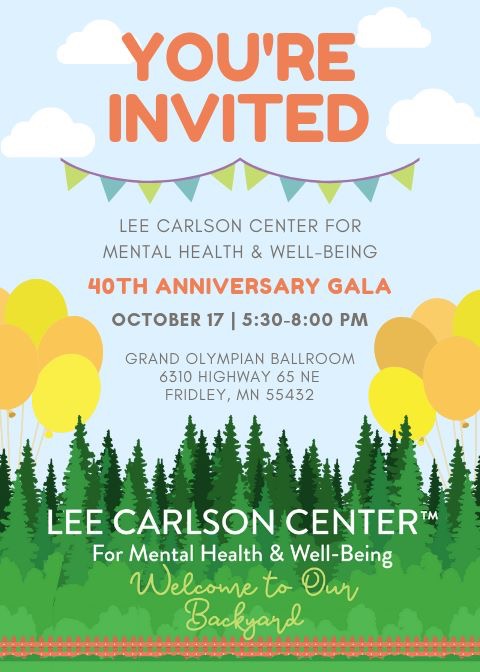
Lee Carlson Center for Mental Health & Well-Being is excited to announce ticket sales are now open for our 40th Anniversary Gala!
Our Theme: Welcome to Our Backyard celebrates Lee Carlson Center’s 40 years here in the Twin Cities North Metro area where we serve over 6,000 clients annually.
Grab your ticket online at: bit.ly/BuyGalaTickets
For information on sponsorships and table purchases, please contact Kate King, Director of Development at kking@leecarlsoncenter.org or call at 763-230-7836.

My journey to working in Public Health began in 10th grade. Yes, 10th grade! There was a woman in my church that offered free step aerobics classes. A friend and I decided to attend. We were on the younger side to be part of this class but, none the less, we went and had a great time. We became regulars in the class and my personal interest in fitness exploded.
My first professional role was in conducting personal training sessions and leading group fitness classes. Working with clients was fulfilling but interactions with them often left me feeling that there was more to health than individual responsibility.
I decided to go a new direction. After a lengthy application process, I was selected to serve as a Community Health Volunteer for the Peace Corps in Fiji. In this role, I was exposed to health programming at the community level. I worked with the children from the school, the village women’s group and a local youth group for teens. With each of these “communities”, the goal was to create programming that addressed their unique needs, was meaningful and made wise use of available resources.
Upon returning home to the States, I wanted to continue my work in Public Health. Now, when I tell people my profession, I am often asked “What actually is Public Health?”
Public Health is a field that seeks to prevent illness and injury from occurring. It works to make the environments in which people live, work, learn and play conducive to good health. Public Health is a broad field and includes public health nurses, health educators, nutritionists, food inspectors, emergency preparedness planners and epidemiologists.
My work falls more under the health education realm. I work on a grant called the Statewide Health Improvement Partnership (SHIP) that strives to “Make the Healthy Choice the Easy Choice.” Within this grant, myself and others implement policy, systems and environment changes through community partners. The best way to explain what this means is to give you some real examples.
First, let’s look at a couple of examples of policy change. Policies surrounding healthy food are often implemented. These policies could include that balanced meals need to be served at employer sponsored events, school vending machines only sell whole foods or hospitals not routinely offering sugar sweetened beverages with meals. Another example of policy change is employers drafting policies for their lactation rooms that are used by mothers to express milk and/or breastfeed.
Next, let’s take a brief look at systems change. This example will be in the health care setting. Healthcare providers often screen for health-related behaviors, like nutrition, exercise and smoking. All too often, patient concerns in these areas go unaddressed. A system change would be for the healthcare provider to refer patients to community resources for nutrition, exercise or tobacco treatment.
Finally, an example of environmental change could be at a food shelf. The food shelf can change their layout to make fresh foods more accessible and put up signs directing shoppers to the healthier items. Another example is an employer putting small exercise equipment in the break room for employees to borrow and use during their workday.
While the opportunities for Public Health programs are endless, priorities are often selected with a focus on health equity. Health equity is working with populations that have historically had poorer health outcomes influenced by factors such as race, income, education, disability and gender. Health equity seeks to level the playing field and allow all people in the community to achieve an optimal level of health.
This brings me full circle. My career began with a focus on individual health behaviors. Now my focus is on health at the community level. Both are important in preventing health issues. Public Health is my passion now as it allows me to focus on health for all people in the community.
-Alyssa Wolf, MS
Health & Well-Being Consultant